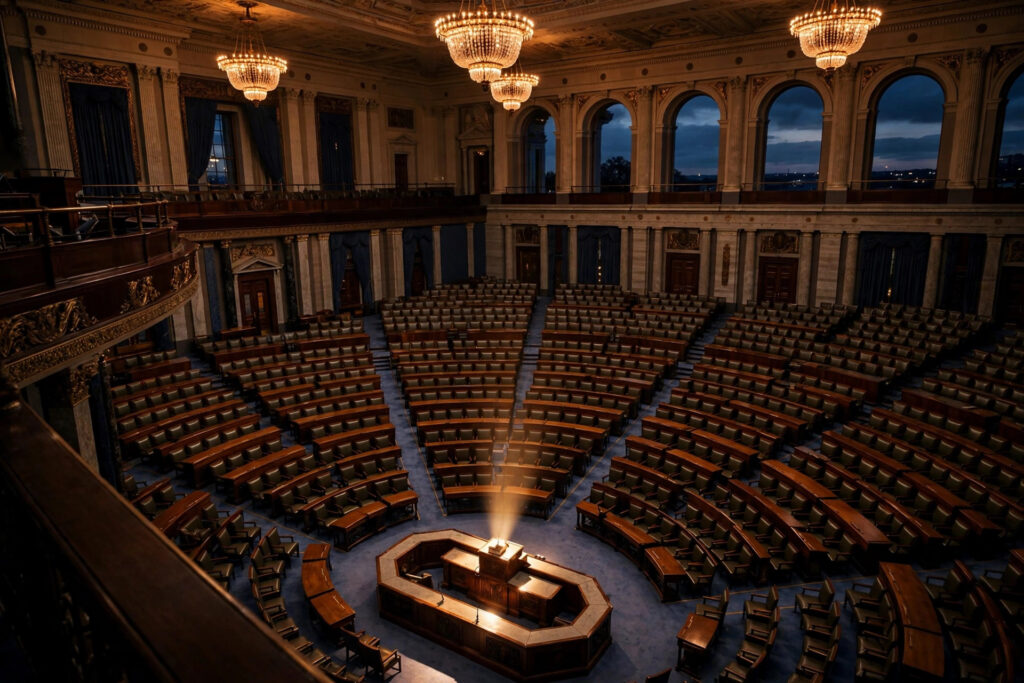
Once a year, the president stands before a joint session of Congress and reports on the condition of the country. The State of the Union address is part constitutional duty, part policy rollout, and part political theater — one of the few moments when the entire federal government gathers in a single room. Here is what the State of the Union address is, where the tradition comes from, and what to watch for when the president delivers it.
Table of Contents
- The Constitutional Basis
- From Written Messages to Spoken Addresses
- The Modern Tradition and Rituals
- Policy, Politics, and Political Theater
- The Opposition Response
- Memorable Moments in SOTU History
- Key Takeaways
The Constitutional Basis
The State of the Union has its roots in Article II, Section 3 of the Constitution, which requires the president to “from time to time give to the Congress Information of the State of the Union, and recommend to their Consideration such Measures as he shall judge necessary and expedient.” That is the entire mandate — a report and recommendations, with no specified format, frequency, or audience.
George Washington delivered the first address in person before Congress in 1790. But the constitutional language is flexible enough that presidents have fulfilled the duty in many ways: spoken addresses, written messages, and even, in the modern era, lengthy written reports supplemented by a televised speech. The form has always followed political fashion.
From Written Messages to Spoken Addresses
Thomas Jefferson broke with Washington’s precedent in 1801, sending his annual message in writing instead of delivering it in person. Jefferson considered a presidential speech before Congress too reminiscent of the British monarch’s address to Parliament. For more than a century, every president followed Jefferson’s example, and the “State of the Union” was a written document read by a clerk.
Woodrow Wilson revived the in-person address in 1913, believing the presidency needed a more direct public voice. The change stuck. Radio carried the speech nationally starting in the 1920s, television from the late 1940s, and today the address reaches tens of millions of viewers — making it the president’s largest guaranteed audience of the year.
The name “State of the Union” itself was not standardized until the 20th century; earlier messages went by titles like the “Annual Message.” Transcripts of every address are archived by the US Congress and presidential libraries, offering a remarkable record of how American priorities have shifted over two centuries.
The Modern Tradition and Rituals
Today’s State of the Union follows a choreographed script. The House Speaker formally invites the president; on the evening of the address, the Sergeant at Arms announces “Mr. Speaker, the President of the United States!” as the president enters the House chamber. The Vice President and House Speaker sit behind the president, applauding or pointedly not applauding as politics dictate.
A “designated survivor” — a Cabinet member who stays away from the Capitol — ensures continuity of government in case of catastrophe. Guests in the First Lady’s box, and members’ invited guests, are chosen to embody the speech’s themes: heroes, victims, and ordinary Americans whose stories illustrate policy points. Applause lines are tested in advance, and the speech is typically the longest prepared address of the president’s year.
First-year presidents technically do not deliver a “State of the Union” — their first address to a joint session is billed as an address to Congress, since they have not yet presided over a full year. The distinction is minor, but traditionalists insist on it.
Policy, Politics, and Political Theater
Substantively, the address is the president’s annual legislative agenda: a wish list of proposals for Congress, framed as a narrative about the country’s direction. Presidents use it to claim credit, assign blame, and set the terms of debate for the year ahead. Many landmark proposals — from health care reform to tax overhauls — were first unveiled or prominently featured in a State of the Union.
But the speech is equally a political performance. The repeated standing ovations from the president’s party, the stony silence from the opposition, the choreographed camera shots of emotional guests — all of it is designed to project strength and momentum. Pundits and pollsters measure the “bounce” in approval ratings afterward, though research suggests these bounces are usually small and short-lived.
Watching how the speech frames economic conditions is often the most revealing part: presidents have strong incentives to talk up the economy, and the gap between the rhetoric and the data tells its own story.
The Opposition Response
Since 1966, the opposition party has delivered an official televised response immediately after the address. The response is a notoriously difficult assignment — a single politician, speaking to a camera in an empty room, following the pageantry of the Capitol. Some responses have launched careers; others, delivered in awkward settings or with memorable gaffes, have become cautionary tales.
In recent years the response format has diversified, with multiple responses from different factions and Spanish-language versions. The ritual underscores the address’s role as the opening move in a year-long political argument rather than a moment of national unity.
Memorable Moments in SOTU History
The State of the Union has produced some of American history’s most quoted presidential lines and most dramatic scenes. Franklin Roosevelt used the address to articulate the Four Freedoms and to rally the nation during World War II. Lyndon Johnson declared “unconditional war on poverty.” Ronald Reagan’s addresses became masterclasses in televised rhetoric, complete with heroic guests in the gallery.
More recent addresses have supplied their own indelible images: partisan walkouts, audible heckling from the floor, and speeches delivered against the backdrop of divided government. Each reflects the political climate of its moment — which is precisely why historians treat the collection of addresses as a barometer of the American presidency itself. For more on presidential communication, see our piece on how the White House shapes public opinion and our guide to executive orders and presidential power.