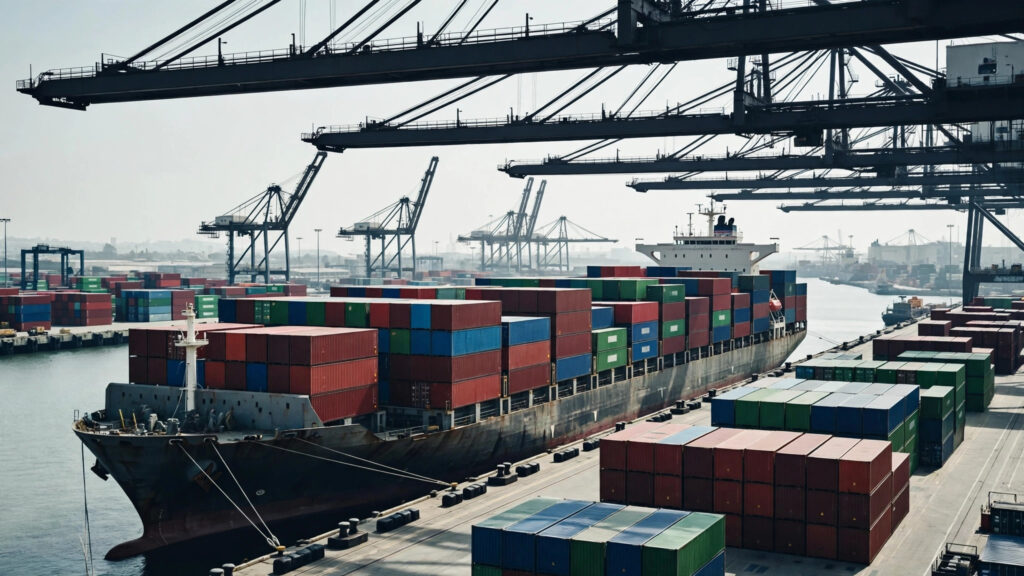
The United States has run a trade deficit for decades, importing more goods and services than it exports. Politicians frequently describe this as America “losing” to other countries, and trade deficits are invoked to justify tariffs, industrial policy, and tough negotiations. But economists are far more divided on what a trade deficit actually means. A deficit can reflect a strong economy with confident consumers, or it can mask genuine problems like eroding industrial capacity. This article explains what the trade deficit really measures, why the US runs one, and when you should actually worry about it.
Table of Contents
- What a Trade Deficit Actually Measures
- Why the United States Runs a Persistent Deficit
- The Case That Deficits Are Not Bad
- The Case That Deficits Are Worrisome
- Do Tariffs Actually Shrink the Deficit?
- What Ordinary Americans Should Watch
- Key Takeaways
What a Trade Deficit Actually Measures
A trade deficit occurs when a country’s imports exceed its exports over a given period. The US trade deficit is reported monthly by the Census Bureau and the Bureau of Economic Analysis, and it has two main components: the goods deficit, which is large, and the services surplus, which is smaller. America imports far more manufactured goods than it sells abroad, but it exports more services, such as finance, software, entertainment, and higher education, than it imports.
A crucial accounting identity sits behind the trade balance: a country’s trade deficit equals the gap between its investment and its savings. When Americans, including the government, businesses, and households combined, invest more than they save, the difference must be financed from abroad, which shows up as a trade deficit. This means the deficit is not simply a scoreboard of trade policy; it is a mirror of the nation’s saving and spending decisions.
This identity has an important implication. Policies that do not change national saving and investment cannot durably change the trade balance. Tariffs, for instance, rearrange which countries America trades with far more than they change the overall deficit, a point that surprises many people but is well established in economic research. For broader context on how trade fits into the economy, see our explainer on the forces driving US economic growth.
Why the United States Runs a Persistent Deficit
Several structural factors keep the US in deficit. First, the dollar’s role as the world’s reserve currency creates constant global demand for dollars and dollar-denominated assets. Foreign investors buy US Treasury bonds, stocks, and real estate, which pushes up the dollar’s value and makes American exports relatively expensive and imports relatively cheap. This “exorbitant privilege” lets the US borrow cheaply but works against its exporters.
Second, the US economy is consumption-driven and grows faster than many trading partners, so Americans buy more imports. Third, federal budget deficits reduce national saving, widening the saving-investment gap that the trade deficit mirrors. When the government borrows heavily, some of that borrowing is financed from abroad, which directly contributes to the trade shortfall.
Fourth, global supply chains are organized around cost advantages. American companies import components and finished goods because doing so lowers costs for consumers and keeps US firms competitive. Unwinding those chains is possible but expensive, which is why reshoring efforts tend to proceed slowly and selectively rather than as a wholesale reversal.
The Case That Deficits Are Not Bad
Many economists argue the trade deficit is mostly benign or even beneficial. Imports give American consumers access to cheaper goods, which raises real living standards: the same paycheck buys more. Competition from imports disciplines domestic producers, holding down prices and forcing innovation. And the capital inflows that mirror the deficit, foreign investment in the US, fund businesses, infrastructure, and government borrowing at lower cost than would otherwise be possible.
There is also a revealing correlation: the US trade deficit has often widened during economic booms, when confident consumers and businesses spend freely, and narrowed during recessions, when spending collapses. By that reading, a growing deficit can be a sign of economic strength, not weakness. Blaming the deficit for economic problems often confuses a symptom with a cause.
Finally, bilateral deficits with specific countries are economically meaningless on their own. The US can run a deficit with one country and a surplus with another; what matters for the overall balance is the aggregate saving-investment position, not any single trading relationship. Fixating on one country’s surplus misses the macroeconomic forest for the bilateral trees.
The Case That Deficits Are Worrisome
The critics have real arguments too. A persistent deficit can hollow out manufacturing employment in specific regions, and the communities hit by import competition have often struggled for decades. The “China shock” research showed that trade adjustment is neither quick nor painless for affected workers, and the geographic concentration of losses fueled lasting political backlash.
There are also strategic concerns. Dependence on foreign suppliers for critical goods, from semiconductors to pharmaceuticals to rare earth minerals, creates vulnerabilities that became painfully visible during recent supply chain disruptions. A deficit driven by offshoring essential industries looks very different from one driven by consumer choice, and national security arguments for domestic production capacity carry weight across the political spectrum.
Additionally, financing consumption with foreign borrowing means the US is selling claims on its future income to the rest of the world. As long as foreign investors eagerly buy American assets, this is sustainable, but it does mean a growing share of US income flows abroad as interest and dividends. Our analysis of how national debt interest crowds out federal spending explores a related dimension of this dependence.
Do Tariffs Actually Shrink the Deficit?
Tariffs are often sold as a cure for the trade deficit, but the evidence is discouraging. Because the deficit reflects the saving-investment balance, tariffs mainly redirect trade rather than reduce the overall gap: imports fall from the targeted country but rise from others, a pattern economists call trade diversion. The overall deficit barely budges unless saving or investment changes.
What tariffs do reliably is raise prices for American consumers and businesses that use imported inputs. Studies of recent tariff rounds found that most of the cost was borne by US importers and consumers, not foreign exporters. Tariffs can protect specific industries and the jobs in them, which is a legitimate policy goal, but they do so at a cost spread across the broader economy.
This does not mean trade policy is pointless. Targeted measures to protect critical industries, enforce fair competition, and address genuine security risks can be justified on their own terms. The mistake is judging them by the trade deficit, a metric they were never well suited to move. Debates over tariffs belong in the realm of politics and industrial strategy, not deficit arithmetic.
What Ordinary Americans Should Watch
For most people, the trade deficit itself is less important than its side effects. Watch import prices: tariffs and a weaker dollar raise the cost of everything from electronics to clothing. Watch manufacturing employment in your region: trade shifts create real winners and losers even when the national picture looks fine. And watch the dollar: its strength or weakness affects travel costs, import prices, and the competitiveness of American exporters.
Census Bureau trade data is published monthly and is worth more attention than the political rhetoric around it. According to the Census Bureau’s reporting, the goods deficit with major partners shifts over time as supply chains reorganize, which tells you more about the real economy than any single month’s headline number.
The bottom line for households is practical: trade affects what you pay and where jobs are, but the deficit number itself is a poor guide to economic health. A deficit during a boom is a very different animal from a deficit during stagnation, and learning to tell the difference is the real skill.